Let’s get to know each other
Accelerate your business potential with our dedicated team.

Brand Consistency
Driving Real Growth
APRIL 08, 2026 6 MINUTES 14 SECONDS
BRANDING
Content
Brand consistency drives growth because recognition compounds — and compounding recognition means lower acquisition costs, higher trust, and customers who come back without being retargeted. Most brands get it wrong not because they don’t care, but because they mistake visual uniformity for actual consistency. Matching logos and colour codes is not the same as creating a coherent experience. And that gap between the two is where growth quietly leaks out.
Ask most brand teams if they’re consistent and they’ll say yes. Ask their customers — and you’ll get a different answer.
Consistency in branding isn’t a design rule. It’s a trust-building system. And most brands haven’t built it yet.
Key Takeaways- Brand consistency is about creating the same feeling at every touchpoint — not just using the same logo.
- Inconsistent branding erodes trust faster than most brands notice, because customers rarely complain about it — they just leave.
- The importance of brand consistency compounds over time; the longer you stay consistent, the cheaper recognition becomes.
- Most brand inconsistency isn’t intentional — it’s a systems failure, not a creativity problem.
- Strong brands don’t choose between consistency and creativity — they use one to fuel the other.
- A brand identity system is what makes consistency scalable without making the brand feel rigid or repetitive.
What Is Brand Consistency in Branding?
Brand consistency is the practice of showing up the same way — in voice, visuals, values, and experience — across every channel, platform, and customer interaction.
What is brand consistency, really? It’s not sameness. It’s coherence. It means a customer who finds you on Instagram, visits your website, receives your packaging, and emails your support team should feel like they’re dealing with the same entity throughout. The tone might shift slightly — more playful on social, more precise in a contract — but the underlying identity stays intact.
Think of it like a person. Someone can be funny in a casual setting and professional in a meeting without feeling like two different people. That’s consistency: a stable core expressed appropriately across different contexts.
What brand consistency is not:
- Repeating the same tagline everywhere
- Using a strict visual template that leaves no room for adaptation
- Treating every channel identically regardless of audience or format
It’s a felt experience, not a checklist.
Why Brand Consistency Is Important for Growth
Why is consistency important in branding? Because recognition compounds, and recognition drives revenue.
The importance of brand consistency shows up directly in purchase behaviour. Customers buy from brands they recognise. They refer brands they trust. And trust is built through repeated, coherent experiences — not one great campaign.
The growth case for consistency:
- Brand recognition strategy gets cheaper over time when the brand is consistent. You spend less convincing people who you are because they already know.
- Brand consistency benefits include higher conversion rates, stronger word-of-mouth, and better retention — because customers know what to expect and get exactly that.
- Lucidpress research found that consistent brand presentation can increase revenue by up to 33%. That’s not a brand feel-good stat. That’s a business outcome.
- Consistent brands don’t have to re-introduce themselves every time they show up. That accumulated familiarity is brand equity — and it’s one of the most defensible assets a business can build.
Inconsistency, on the other hand, makes every touchpoint feel like a first impression. And first impressions are expensive.

Where Brand Consistency Breaks Down for Most Brands
Brand inconsistency rarely happens because a team decided to be inconsistent. It happens because consistency was never operationalised — it lived in someone’s head instead of a system.
Here’s where the lack of alignment usually shows up first:
- Across teams – Marketing writes one way, sales talks another way, customer support improvises. No shared language, no shared standards.
- Across channels – The Instagram profile and the website feel like different brands. The email newsletter has a different personality than the landing page.
- Across time – The brand evolves — new campaigns, new hires, new agency relationships — but no one updates or enforces the core identity. Drift sets in.
- Across regions or markets – Global brands localise without guardrails and lose coherence in the process.
Branding challenges like these aren’t solved by better designers or better writers. They’re solved by better systems. Inconsistent branding is almost always a process problem wearing a creative mask.
Common Branding Mistakes That Lead to Inconsistent Branding
The branding mistakes that cause inconsistency tend to follow predictable patterns. Most of them are avoidable — but only if you know what to look for.
The most common ones:
- No documented brand identity system – If brand standards only exist in someone’s memory or an outdated PDF, they won’t travel across teams or time. To understand how a strong foundation works, read more about brand identity
- Weak or vague brand messaging – When the core message isn’t sharp, every person who touches it interprets it differently. The result is inconsistent branding that accumulates across every piece of content.
- Treating a brand as a one-time project – Brands get a refresh, launch with fanfare, and then the new identity slowly gets diluted as old habits creep back in.
- Over-customising by channel – Adapting tone and format for each platform is smart. Reinventing the personality for each platform is brand inconsistency in disguise.
- Inconsistent brand messaging in campaigns – Each campaign tells a slightly different story. Over time, customers don’t know what the brand actually stands for.
The brands that avoid these mistakes aren’t more disciplined by nature — they’ve just built the infrastructure that makes consistency the path of least resistance.
How Strong Brands Build Brand Consistency Through Systems
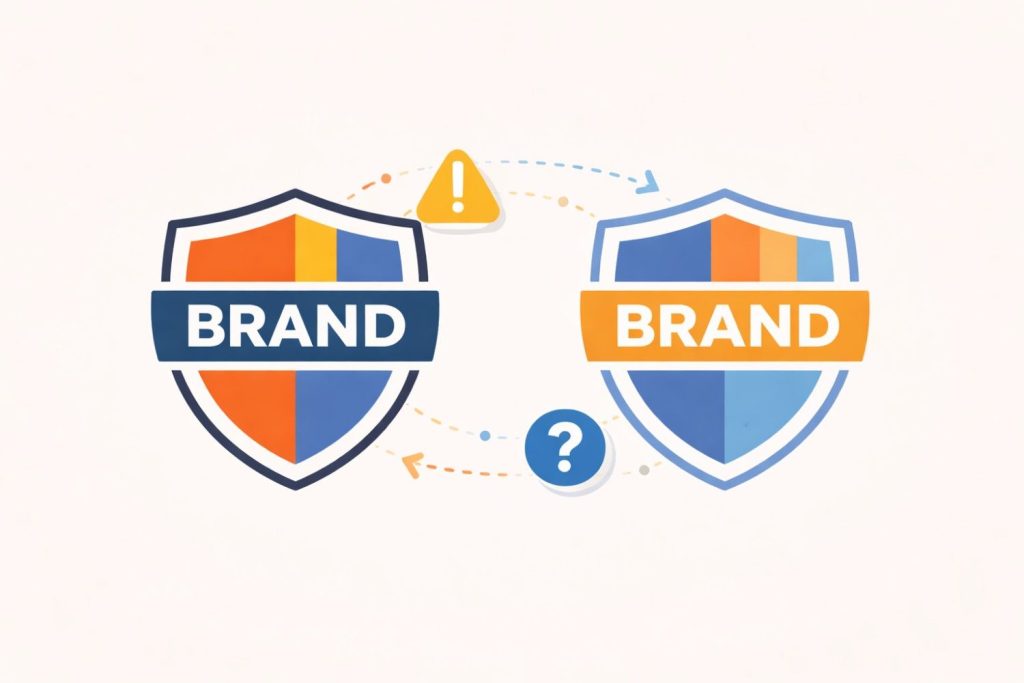
The best brand consistency examples — Nike, Apple, Patagonia — aren’t consistent because they’re creatively restrained. They’re consistent because they’ve built systems that make consistency easy and inconsistency difficult.
A brand identity system is the foundation. It’s more than a logo and colour palette. It includes:
- Core messaging architecture — the brand promise, positioning, and voice that every piece of communication should reflect
- Visual standards — typography, colour, imagery style, layout principles that travel across formats
- Branding guidelines that are practical, not just aspirational — specific enough that a new hire can use them on day one
- Tone of voice documentation — with real examples of what the brand sounds like across different contexts
Consistent brand messaging is the output of a well-built system, not the result of everyone trying really hard. When the system is right, consistency scales. When it isn’t, inconsistency scales instead.
Brand consistency examples that stand out don’t just have good guidelines — they have cultures that treat the brand as a shared responsibility, not just a marketing asset.
Balancing Consistency and Creativity in Branding
Most Brand Teams experience this tension: too much consistency = boring; too much creativity = inconsistency. This is a false dichotomy.
Brand creativity does not mean giving up brand consistency. Brand creativity begins with the existing strong brand identity; it is finding new and surprising expressions of that identity. The constraints are what creates the possibilities.
Creative branding examples prove this repeatedly:
- Oatly reinvents its packaging copy constantly — but the quirky, direct, slightly self-aware personality never wavers.
- Innocent Drinks has run thousands of different campaigns — the warmth and wit stay the same.
- Apple changes everything in a product launch campaign — the simplicity and the premium feel never do.
The importance of creativity in marketing isn’t in question. But creativity without a consistent brand identity behind it is just noise. Creative brand strategy at its best uses a stable identity as a springboard — not a cage.
How to build a strong brand identity that allows for creative freedom:
- Capture the emotion that the brand should evoke; allow flexibility in how it is designed.
- Identify what is non-negotiable (values, tone, core visual elements), and what is flexible (formats executions, campaigns).
- Let teams create freely within the guidelines rather than replacing the guidelines.
How to maintain brand consistency while staying creatively fresh is less about policing and more about building a brand that teams actually want to stay true to — because it’s strong, clear, and something worth protecting.

Conclusion
Brand consistency isn’t the enemy of creativity. It isn’t a rigid rulebook. And it isn’t just a design concern.
It’s the compound interest of brand-building. Every consistent touchpoint adds to a reserve of recognition and trust that makes every future marketing effort more effective. Every inconsistent touchpoint quietly drains it.
The brands that get this right don’t just look consistent. They feel consistent — and that feeling is what customers come back for.
And if that consistency feels harder to build than it should, it’s usually a sign that the foundation needs clarity. That’s where the right strategic lens can make all the difference — aligning how your brand shows up with how it’s meant to be experienced. That’s the work we focus on at SimplePlan.
Frequently Asked Questions
-
How to build a strong brand identity?
Start with a clear brand messaging architecture — define the promise, the personality, and the values. Then build a visual and verbal system that expresses those consistently. Document it, train teams on it, and revisit it regularly to catch drift before it compounds.
- How to maintain brand consistency?
- Why does brand consistency drive growth?
- What happens when a brand is inconsistent?
- How does brand consistency impact conversions?
- Can small brands benefit from brand consistency?
Let’s get to know each other
Accelerate your business potential with our dedicated team.