Let’s get to know each other
Accelerate your business potential with our dedicated team.

D2C Growth
Why Brands Stall After Initial Traction
APRIL 08, 2026 5 MINUTES 55 SECONDS
BRANDING
Content
Most D2C brands fail after initial growth for one reason: they confuse an acquisition spike with a sustainable business. The product didn’t fail. The retention didn’t exist. The brand was never built. And the paid media engine that drove early sales eventually ran out of easy audience — leaving nothing underneath to hold the growth up.
Key Takeaways- Early D2C growth is mostly a paid media phenomenon — it’s not proof that the business model works long-term.
- A sustainable growth rate requires retention, not just acquisition.
- Most D2C brands plateau because they optimise for the first sale and ignore everything after it.
- Brand vs performance marketing is a false choice — brands that scale well invest in both simultaneously.
- Lack of differentiation is the silent killer; when you look like every other brand in the category, price becomes the only differentiator.
- Breaking the plateau means shifting from a traffic model to a loyalty model.
What “Initial Growth” Really Means for D2C Brands
Initial growth for most D2C brands means the paid acquisition engine is working — not that the business model is. That’s the distinction most founders miss, and it’s an expensive one.
The D2C business model at its early stage runs on a simple equation: spend on Meta or Google, acquire customers, ship product, repeat. When that loop works, it feels like traction. Revenue is real. The brand is growing. But underneath it, the unit economics are fragile.
What’s actually happening in most early D2C examples:
- A small, highly relevant audience converts well at low CAC
- Word-of-mouth from early adopters inflates organic numbers
- The product is novel enough that repeat purchase rates look healthy
- The brand hasn’t yet had to fight for attention in a saturated feed
The sustainable growth rate — the pace a brand can grow without burning cash or diluting the brand — is a different number entirely. Most brands don’t calculate it until the plateau forces them to.
Why Most D2C Brands Plateau After Early Success
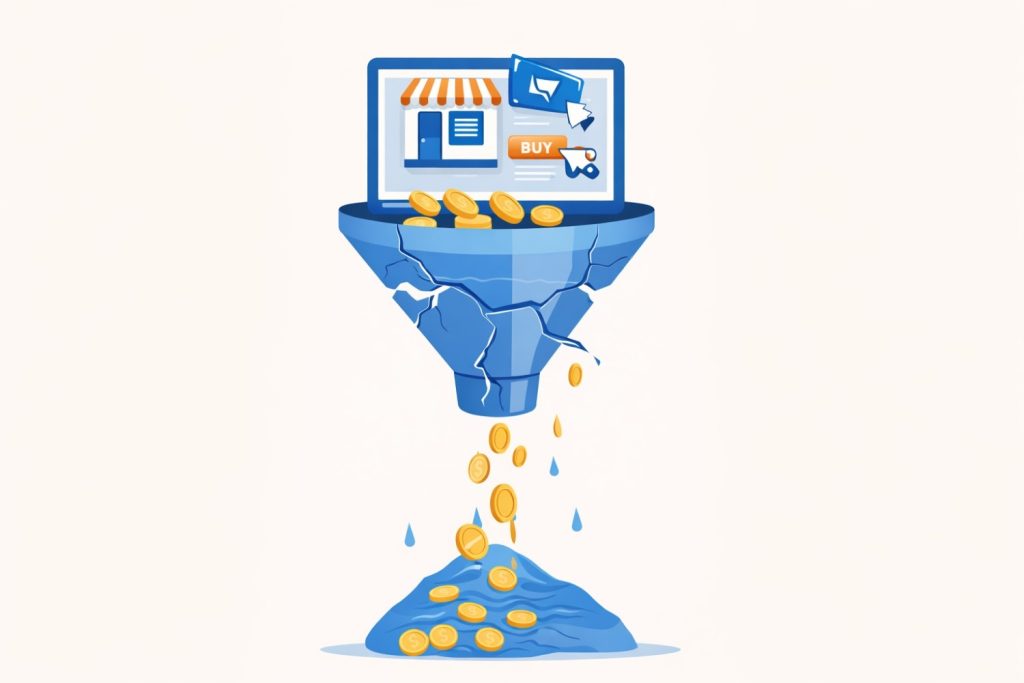
D2C brands plateau when their ecommerce growth strategy is almost entirely acquisition-dependent. When the easy audience runs out, CAC rises, margins compress, and growth stalls — fast.
Here’s what the plateau actually looks like:
- As each month passes, the cost to acquire new customers is increasing;
- Despite no changes to the existing creative assets or audiences, the return on ads is less
- While the number of newly acquired customers stays steady, revenue per newly acquired customer has decreased significantly;
- The brand has to keep running faster just to maintain its position.
KNOW MORE: THE LEAN D2C FUNNEL
Scaling an ecommerce business isn’t just about spending more. It’s about building the infrastructure that makes spending more work: retention loops, brand equity, a product range that earns repeat purchases.
D2C strategies that only focus on the top of the funnel hit a ceiling. Every audience has a saturation point. When you reach it, you either build a brand strong enough to pull people in on its own — or you pay more and more for the same result.
The Hidden Causes Behind D2C Growth Plateaus
The surface cause of most plateaus is rising CAC. The real cause is almost always poor customer retention — and a brand that was never built to earn the second purchase.
Most D2C brands are optimised for conversion, not for loyalty. The post-purchase experience — the emails, the packaging, the customer service, the re-engagement — gets a fraction of the attention the ad creative gets. That’s the gap where growth leaks out.
The hidden causes, broken down:
- Acquisition vs retention imbalance – Brands spend 80% of their budget acquiring customers and almost nothing keeping them. When LTV is low, the acquisition model eventually stops paying for itself.
- Brand vs performance marketing misalignment – Performance drives the first click. Brand earns the second, third, and fourth purchase. Brands that only invest in performance marketing are essentially refilling a leaking bucket.
- Weak retention marketing strategy – Email and SMS are treated as broadcast channels instead of relationship tools. Flows are generic, segmentation is minimal, and the communication feels transactional.
- Conversion vs retention confusion – Optimising for conversion rate on the first purchase is not the same as optimising for a customer who comes back. These require different strategies, different messaging, different incentives.
The brands that scale past the plateau aren’t spending less on acquisition. They’re spending more on retention — and it changes the maths entirely.
Common Mistakes That Stop D2C Brands from Scaling
The mistakes aren’t always obvious. Most D2C strategies that stall look fine on the surface — good product, decent margins, solid creative. The problems are structural.
The most common ones:
- Lack of differentiation – When the product looks and sounds like everything else in the category, price becomes the only lever. That’s a race no brand wins long-term. Customers who came for a discount leave for a better discount.
- Over-reliance on one channel – A brand built entirely on Meta ads isn’t a brand — it’s a media buy. When CPMs rise or iOS updates hit, the whole business wobbles.
- No post-purchase strategy – The customer buys, gets a shipping confirmation, and then hears nothing meaningful until the next promotion. That silence is a retention failure.
- Ignoring acquisition vs retention economics – Acquiring a new customer costs five to seven times more than retaining an existing one. Brands that don’t build for retention are chronically overpaying for growth.
- Scaling creative without scaling brand – More ad spend on a weak brand identity just accelerates the race to the bottom. You can’t media-buy your way to loyalty.
None of these are unfixable. But most brands catch them late — after the plateau has already set in and the budget is already under pressure.

Breaking the Plateau: How D2C Brands Scale Sustainably
D2C branding is what breaks the plateau. Not better targeting. Not lower CPCs. A brand strong enough that people seek it out, talk about it, and come back without being retargeted.
D2C brand strategy for scaling sustainably means building on three pillars:
- Retention infrastructure — Email, SMS, loyalty programmes, and post-purchase flows that actually earn the next purchase rather than just announcing it.
- Brand equity — A clear point of view, a distinct visual identity, and a tone that makes the brand recognisable without seeing the logo. This is what makes paid media more efficient over time, not less.
- Community and advocacy — Turning existing customers into acquisition channels. Referrals, UGC, and word-of-mouth lower CAC more sustainably than any optimisation tweak.
The shift isn’t from performance to brand — it’s from only performance to performance plus brand. Both have to work together for ecommerce growth strategy to compound rather than plateau.
What Actually Drives Sustainable Growth in D2C Brands
Sustainable growth in D2C comes from one thing: a high LTV that justifies the CAC. Everything else is downstream of that.
How to increase ecommerce sales sustainably — not just spike them:
- Build for the second purchase first – The onboarding experience, the first email, the packaging — design all of it to earn the next order, not just celebrate the current one.
- Segment and personalise retention – Generic broadcast emails are noise. Flows built around customer behaviour, purchase history, and engagement convert at multiples of the average.
- Invest in content that compounds – SEO, organic social, and community content take longer to build but don’t disappear when ad budgets get cut.
- Track LTV by cohort, not just by month – Cohort-based LTV shows you whether retention is improving or deteriorating — before it shows up in revenue.
- Build a reason to come back that isn’t a discount – New products, exclusive content, community access, early launches — reasons to return that protect margin while building loyalty.
The D2C business model works long-term when the brand earns trust faster than it spends on acquisition. That’s the formula. Everything else is execution.

Conclusion
The plateau isn’t the end of the story — it’s the brand’s first real test.
The brands that break through it are the ones that stop treating growth as a paid media problem and start treating it as a brand-building one. They strengthen retention, sharpen differentiation, and put as much focus on the second purchase as they do on the first.
D2C brands that reach genuine scale don’t get there by outspending the competition. They get there by being worth coming back to.
That’s the whole game.
And if you’re at that stage where growth feels harder than it should, it’s usually not about doing more; it’s about getting clearer on what your brand stands for and how it shows up. That’s where the right strategic lens can change everything — which is exactly the work we do at SimplePlan.
Frequently Asked Questions
-
Why do D2C brands fail after initial growth?
Most D2C brands fail after initial growth because early success is driven by paid acquisition rather than genuine brand loyalty or strong retention. Once the easiest audience is saturated, CAC rises and the model breaks down without retention infrastructure to support it.
- How can D2C brands achieve sustainable growth?
- What are the common signs a D2C brand is plateauing?
- Why does retention become critical after initial growth?
Let’s get to know each other
Accelerate your business potential with our dedicated team.