Let’s get to know each other
Accelerate your business potential with our dedicated team.

Founder-Led Branding
Should You Be the Face of Your Brand?
April 09, 2026 6 MINUTES 04 SECONDS
Content
The answer isn’t the same for every founder — but here’s the honest version: if you’re building a business where trust, expertise, or community matter, founder visibility almost always accelerates growth in the early stages. The question isn’t really should you show up. It’s how much, in what way, and what happens to the brand when you do.
Most founders either avoid being the face entirely — hiding behind the company logo — or go all-in on personal content without thinking about what that does to the business long-term. Both extremes have a cost. The right answer sits somewhere in between, and it depends on the kind of brand you’re actually trying to build.
Personal brand vs business brand isn’t an either/or. It’s a sequence — and knowing where you are in it changes everything.
Key Takeaways- Founder visibility accelerates early trust — but without a parallel company brand, it creates a business that can’t exist without you.
- Personal brand vs business brand isn’t a permanent choice — it’s a strategic evolution over time.
- The importance of personal branding is highest in categories where people buy from people, not from logos.
- A founder-led brand is an asset in early growth and a liability at scale if it’s never transitioned.
- Long-term brand building requires the company to develop its own identity — separate from the founder’s.
- The best founder marketing strategy builds both simultaneously — using personal visibility to fund company brand equity.
What Does It Mean to Be the Face of a Brand?

Being the face of a brand means the founder’s identity — their name, voice, story, and credibility — becomes part of how the business earns trust. It’s not just about posting on LinkedIn. It’s about the founder brand becoming a signal that customers use to decide whether to buy, follow, or refer.
Founder branding sits on a spectrum:
- Implicit — the founder’s values and personality shape the brand culture, even if they’re not front and centre publicly
- Active — the founder shows up regularly on social, in media, at events, as a visible representative of what the company stands for
- Central — the founder is the brand; the business’s credibility is almost entirely tied to their personal reputation
Most founder brands start somewhere in the middle and drift toward one extreme or the other. The ones that scale well are deliberate about which direction they’re moving — and why.
Should You Build a Founder-Led Brand or a Brand-Led Business?
Founder-led companies tend to grow faster early on. Brand-led businesses tend to be worth more later. The tension between the two is one of the defining strategic decisions a founder makes — often without realising they’re making it.
A founder-led model works well when:
- The founder has genuine authority or expertise in the category
- The product requires trust before purchase — coaching, SaaS, professional services, high-consideration goods
- The market is crowded and a human face cuts through faster than a logo
- The founder has something distinct to say — a point of view, not just a presence
A brand-led model makes more sense when:
- The business needs to be acquirable or investable without the founder
- The category doesn’t reward personal visibility — FMCG, B2B enterprise, infrastructure products
- The founder genuinely doesn’t want to be a public figure and would burn out trying to be one
Personal brand strategy at this stage is about being honest: are you building a platform for yourself that a business sits under, or a business that briefly uses your face to get traction? Both are valid. Conflating them is where it gets messy.
What Are the Real Benefits and Hidden Risks of Founder Visibility?
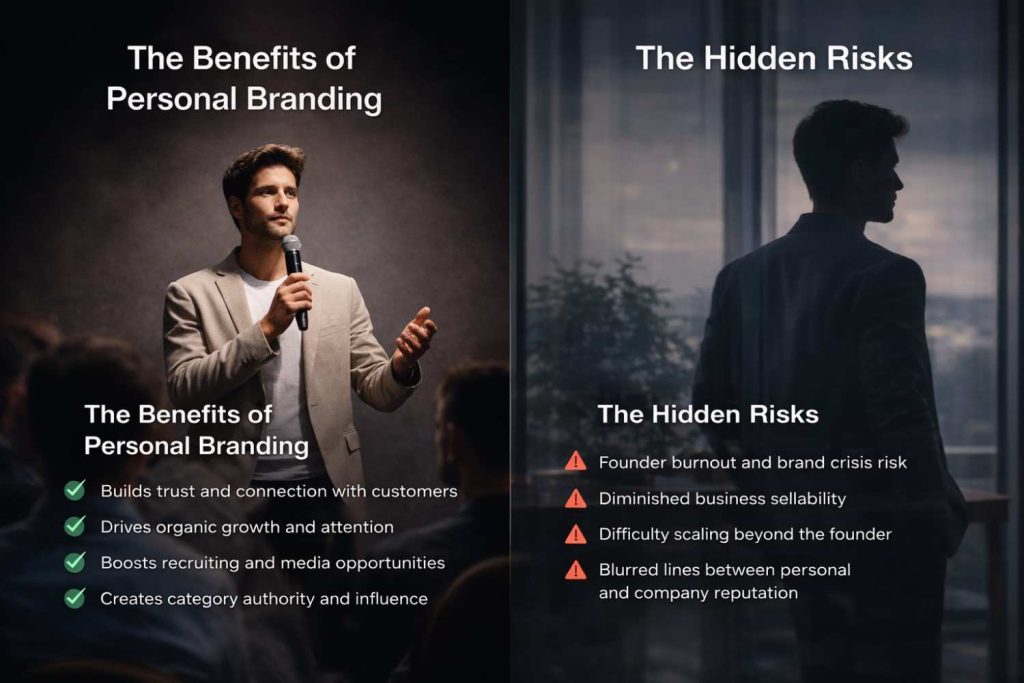
The importance of personal branding for founders is real — but it’s also unevenly discussed. The benefits get amplified; the risks get footnoted.
The benefits of personal branding:
- Trust transfers faster. Customers connect with people before they connect with companies.
- Content compounds. A founder with a point of view generates organic reach that no ad budget replicates easily.
- Recruiting improves. People want to work with founders they respect, not just companies they’ve heard of.
- Personal branding for founders creates media leverage — press, podcast invitations, speaking slots — that builds brand awareness at low cost.
- Founder visibility creates category authority. If you’re the person most associated with a problem, customers find you before they find your competitors.
The hidden risks:
- The business becomes unsellable or unfundable if the founder’s personal brand is the only brand equity.
- Founder burnout hits differently when your personal reputation is tied to the company’s every move.
- A PR crisis around the founder is a brand crisis — there’s no separation to retreat behind.
- Scaling past a certain point requires the brand architect to step back from being the face and become the builder. That transition is harder when you’ve built an audience around yourself.
The risks aren’t reasons to stay invisible. They’re reasons to build strategically from the start.
Should You Be the Face of Your Brand?
Yes — with conditions. The honest framework is this: show up as the face of the brand until the company brand is strong enough to stand without you, then transition deliberately.
How to build brands that don’t collapse when the founder steps back starts with building both in parallel from day one:
- Use personal visibility for reach and trust early on
- Simultaneously invest in marketing foundations that aren’t founder-dependent — SEO, brand identity, community, customer advocacy
- Make sure the company has a clear voice and identity that doesn’t require your face to feel alive
The founders who do this well don’t disappear — they evolve. They move from being the face of the brand to being the signal of its values. The brand can carry more weight on its own, but the founder’s presence still adds credibility rather than carrying all of it.
Founder Brand vs Company Brand: Which Builds Long-Term Value
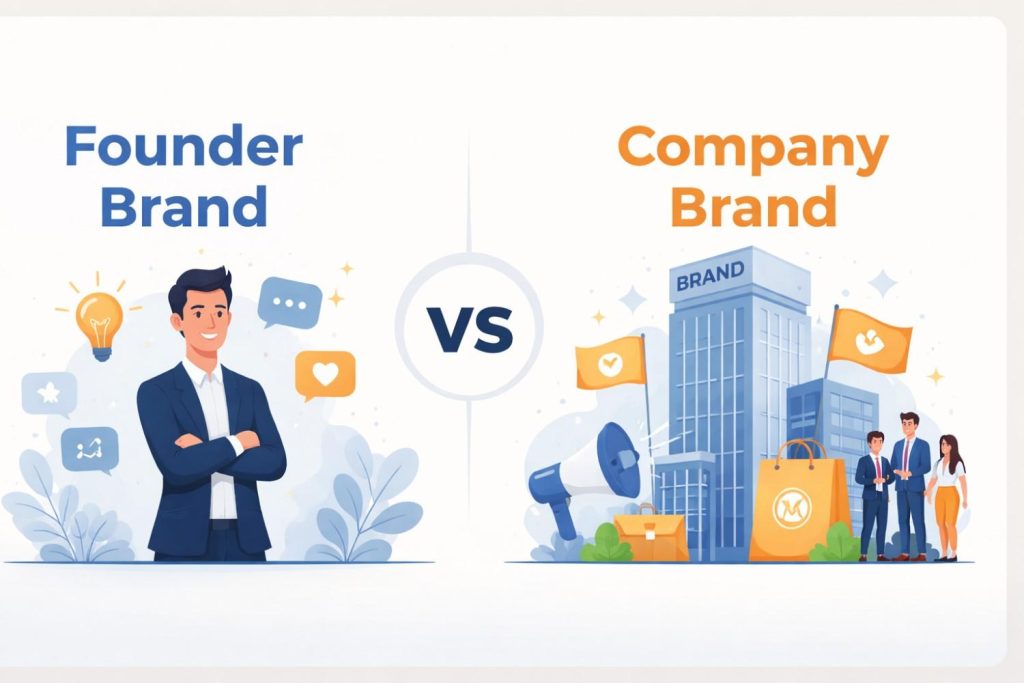
For long-term brand building, the company brand wins. A personal brand is tied to a person — it doesn’t transfer, can’t be scaled by a team, and doesn’t survive the founder’s exit. A company brand, built well, outlasts everyone who built it.
But here’s the nuance: personal branding vs business branding isn’t a competition in the early stages. The personal brand funds the company brand. The founder’s credibility is the fastest way to earn the trust that the company brand will eventually hold on its own.
Brand building that compounds over time looks like this:
- Founder visibility creates initial audience and trust
- That audience becomes the company’s audience — email list, community, customer base
- The company invests in owned brand equity: content, product reputation, customer experience
- Over time, marketing frameworks shift from founder-led to brand-led, and the transition feels natural rather than jarring
Personal branding vs business branding is a timeline question, not a values question. The goal is always a business that doesn’t depend on any one person to survive.
How to Decide: A Practical Framework for Founders
Personal brand strategy at the decision point comes down to four questions:
- Does your category reward personal visibility?
If customers research the founder before buying — yes. If the purchase is entirely product-driven — less so. - Do you have a genuine point of view worth sharing?
Presence without substance is noise. Founder marketing strategy only works if the founder has something to say that the audience can’t get elsewhere. - Are you building to sell, or building to hold?
If an exit is on the horizon, build the company brand harder and faster. A business priced on founder equity is a harder sell. - Can you sustain it?
How to build a personal brand that lasts isn’t about volume — it’s about consistency over time. How long does it take to build a personal brand that carries real weight? Typically two to four years of consistent, specific, valuable content in a defined niche.
Why personal branding matters ultimately isn’t about vanity metrics. It’s about building a distribution channel, a trust signal, and a recruitment asset — all at once. Done well, it’s one of the highest-leverage things a founder can invest time in. Done without a plan, it creates a dependency the business will eventually have to break.

Conclusion
There’s no universal answer to whether you should be the face of your brand. But there’s a universal truth underneath the question: founder visibility is a tool, not an identity. Use it to build something that doesn’t need it.
The best founder brands are the ones where, five years in, the company could stand on its own — and the founder chooses to stay visible because it still adds value, not because the brand can’t survive without them.
That’s the difference between a founder-led brand and a founder-dependent one. Build the first. Avoid the second.
And if you’re figuring out how your brand should show up — with or without you at the center — it usually comes down to clarity in positioning and structure. That’s the work we focus on at SimplePlan: building brands that can grow beyond the founder, without losing what makes them powerful in the first place.
Frequently Asked Questions
-
How to build a personal brand as a founder?
Start with a specific niche and a consistent point of view. Show up regularly in the channels your target audience actually uses. Document your thinking, your process, and your perspective — not just your wins. Consistency over six to twelve months builds more than a burst of activity ever will.
- How long does it take to build a personal brand?
- Why personal branding matters for founders?
Let’s get to know each other
Accelerate your business potential with our dedicated team.