Let’s get to know each other
Accelerate your business potential with our dedicated team.

The Perception Gap
What You Say vs What People Experience
April 07,2026 5 MINUTES 37 SECONDS
BRANDING
Content
There’s a quiet problem sitting inside most brands — and it has nothing to do with bad products or poor service. It’s the perception gap: the distance between what a brand intends to communicate and what customers actually feel when they encounter it.
That gap, even a small one, costs real money, real trust, and real growth. And the tricky part? Most brands don’t know it exists until something breaks.
Key Takeaways- The perception gap is the difference between your intended brand message and what customers actually experience.
- Inconsistent branding across channels is one of the fastest ways to erode customer trust.
- Most common branding mistakes stem from speaking to yourself instead of your audience.
- A conversion gap is often a symptom of a deeper perception problem, not a marketing tactic failure.
- Closing the gap starts with a perception gap analysis — not more ad spend.
- Strong brand messaging strategy aligns internal values with external experience, consistently.
What Is the Perception Gap in Branding?
The perception gap in branding is the mismatch between how a company sees itself and how its customers actually perceive it.
You might position yourself as approachable and customer-first. But if your support takes three days to respond and your website reads like a legal document, customers experience something completely different. That disconnect is the gap.
Brand perception research backs this up starkly. A Forbes-cited study found:
- 80% of companies believed they were delivering a superior customer experience
- Only 8% of customers agreed
That’s not a marketing problem. That’s a branding perception problem — and it runs deep.
Understanding the perceived gap means being honest about the distance between your internal narrative and the story customers are actually telling about you.
A classic example: Gap (the clothing brand) lost touch with its core audience in the 2000s by chasing trends instead of reinforcing what made it resonate. The brand said one thing. The experience delivered another. Brand perception examples like this show how fast the slide can happen.
Why the Perception Gap Happens
The perception gap forms when brand messaging is built around what a company wants to be rather than what customers need to hear. It’s one of the most common branding mistakes — and it happens gradually, not overnight.
A few patterns show up repeatedly:
- Internal language bleeds into external copy – Words the team loves, jargon that sounds strategic, phrases that impress in boardrooms but confuse on a homepage.
- Brand voice drifts across teams – One team writes the website, another runs social, a third handles sales emails — and no one is making sure it all sounds like the same company.
- Promise outpaces delivery – The marketing messaging says “seamless experience,” but the product onboarding is clunky and checkout has four unnecessary steps.
These branding mistakes don’t happen because people aren’t trying. They happen because there’s no system to regularly pressure-test what the brand says against what customers actually feel.
If you want to go deeper into how brands are actually built:
KNOW MORE: STAGES OF BRANDING PROCESS
The Hidden Cost of the Perception Gap on Growth
A perception gap doesn’t just hurt brand equity — it directly kills revenue.
When what you say and what people experience don’t match, you lose the ability to build brand trust. And trust is what moves people from interest to purchase.
Here’s how it compounds:
- Customers can’t reconcile your promise with their experience
- You develop a conversion gap — traffic that doesn’t convert, trials that don’t renew, referrals that never come
- Retention leaks silently while you spend more on acquisition
- CAC climbs and the performance marketing budget absorbs the blame — when the real issue is a brand that doesn’t hold up under scrutiny
Brand trust insights from high-performing brands consistently show one thing: when trust is intact, conversion follows. When it’s not, no campaign fixes it.
Common Signs Your Brand Has a Perception Gap
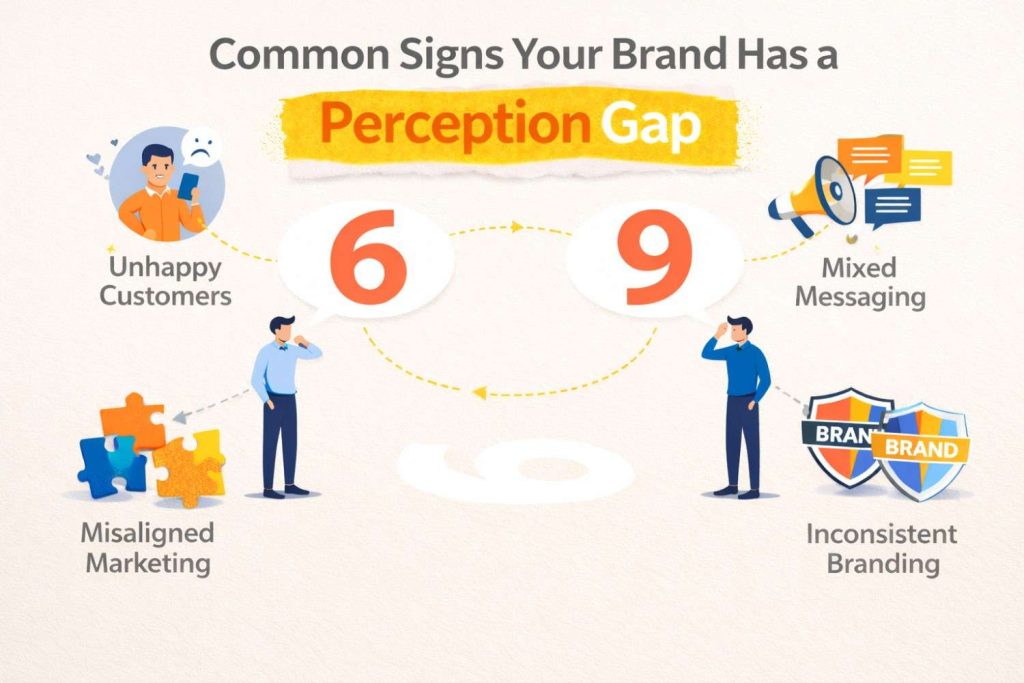
The clearest sign? When customers describe your brand, the words they use surprise you. That surprise is the gap.
Be aware of the following warnings:
- Users may respond in different ways to the same brand message based on their channel
- Your sales force and your website may both describe ‘the product’ in different manners
- There could be information about your product from customer reviews that you have not promoted either positively or negatively
- Your prospects could be asking basic questions that should already have been addressed by the content on your company’s home page
- Inconsistent branding across touchpoints leaves customers unsure what you actually stand for
Branding problems like high churn, low repeat purchase, or a disengaged audience often trace back to perception before they trace back to product.
When customers can’t form a clear, consistent mental image of what a brand is and who it’s for, they default to indifference. Brand perception isn’t something customers consciously decide — it’s something they absorb. And if you’re not controlling what they absorb, the gap fills itself.
The Perception Gap Framework: Where Brands Break Down
A solid brand messaging framework for diagnosing perception gaps looks at three layers:
| Layer | The Question |
| What you say | Is the message clear, consistent, and audience-first? |
| How you say it | Does the tone and voice hold across every channel? |
| What people experience | Does the actual product/service confirm the promise? |
Breakdowns happen at all three — but they’re most damaging when all three are misaligned at once.
Most teams stop their messaging framework at “what we say” — a brand voice guide, a tagline, some positioning statements. Necessary, but not enough.
A brand that claims to be bold and decisive but has six approval layers before a tweet goes out is not living its positioning. The brand messaging can be brilliant, the visual identity clean — but if the thing people actually use doesn’t feel like what the brand promised, trust erodes quietly and quickly.
How to Close the Perception Gap
Closing the gap starts with a perception gap analysis — an honest audit of how you describe your brand versus how customers actually describe it.
Start here:
- Survey your customers with open-ended questions about how they’d describe the brand
- Read reviews without defensiveness — look for recurring words you didn’t put there
- Compare homepage copy against what your sales team says on calls
- The delta you find is your starting point
From there, a strong brand messaging strategy has to do two things simultaneously:
- Sharpen what you say externally
- Align how the brand shows up internally — at every touchpoint

Perception strategies that actually work tend to be unglamorous:
- Consistent language training for customer-facing teams
- A single brand voice document that actually gets used
- Quarterly checks against real customer language
- Fixing experience gaps before amplifying messaging
Perception in marketing matters — but perceptions branding is a whole-company problem. Marketing can’t fix what the product or support experience breaks. Improve brand perception not by rebranding cosmetically, but by closing the distance between promise and experience, one touchpoint at a time.
The goal of brand enhancing isn’t to make the brand sound better. It’s to make the brand be better — and then communicate that honestly.
Conclusion
The perception gap is not a crisis. It’s a calibration problem — and it’s fixable.
The brands that close it aren’t necessarily the ones with the biggest budgets or the cleverest campaigns. They’re the ones that stay honest about the distance between intention and experience, and take steady steps to close it.
Perceptions branding is an ongoing practice, not a one-time project. Customers update their impressions constantly. The brands that earn lasting trust are the ones that keep asking: Is what we say actually what people feel?
When the answer is yes — that’s where growth lives.
And if you’re trying to close that gap, sometimes an outside perspective makes all the difference. That’s exactly the work we do at SimplePlan — bringing clarity to what your brand says, and aligning it with what people actually experience.
Frequently Asked Questions
-
What is the perception gap in branding?
The perception gap is the difference between the image a brand intends to project and the image customers actually hold. It forms when messaging, experience, and reality don’t align.
- How can companies fix brand perception gaps?
- Why does the perception gap hurt conversions?
- How can I tell if my brand has a perception gap?
- How do you fix the perception gap?
Let’s get to know each other
Accelerate your business potential with our dedicated team.