Let’s get to know each other
Accelerate your business potential with our dedicated team.

The Hidden Cost
Marketing Without a Strong Brand
April 14, 2026 4 MINUTES 57 SECONDS
BRANDING
Content
Your marketing is destined to fail without a clear brand strategy because branding creates clarity, consistency, and trust. Without that foundation, even good marketing that generates attention might struggle with conversion, scale, and long-term growth.
This is the pattern we see repeatedly. Brands invest in campaigns, follow the fundamentals of marketing, hire agencies, test creatives, and still wonder why momentum fades. The real issue is not the efforts. It is usually the absence of a strong brand strategy underneath the marketing that lays down the base.
Let’s unpack why this keeps happening.
Key Takeaways- Good marketing cannot compensate for weak brand positioning.
- Brand consistency builds trust faster than creative spikes do.
- Confusing brand messaging reduces long-term conversion and might even result in customer dropoffs.
- Branding before marketing improves sustainability. It works as a guiding map your brand can follow.
- Brand-led marketing strengthens loyalty and retention.
Why Marketing Fails Without a Clear Brand Strategy
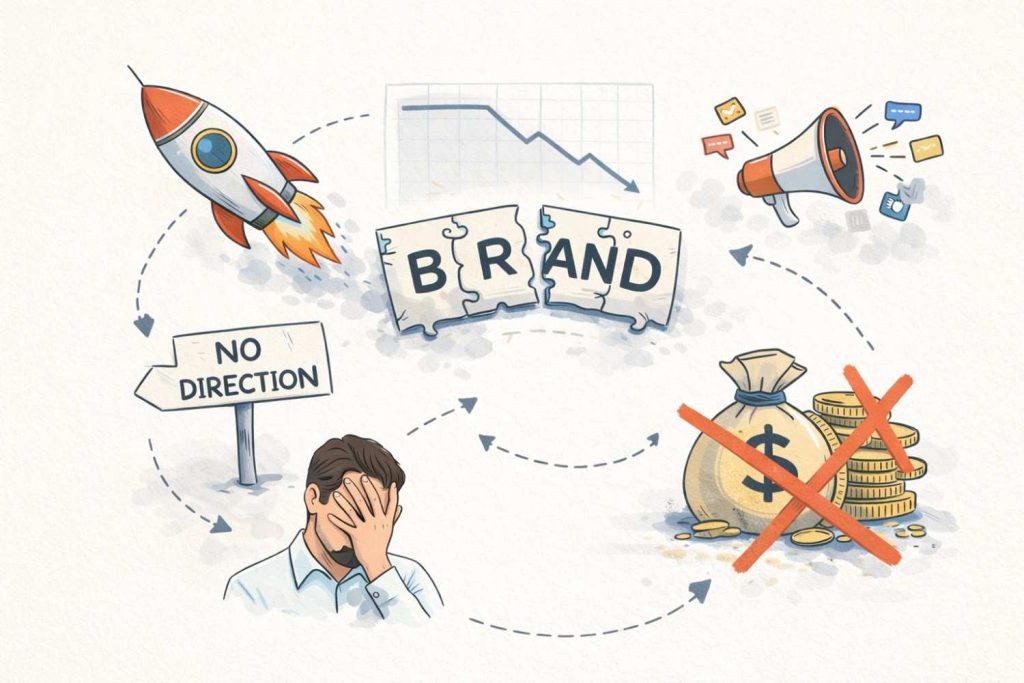
The Illusion of Good Marketing
On the surface, good marketing looks successful.
You see:
- High impressions
- Strong reach
- A spike in engagement
- Early conversions
But attention is not the same as clarity.
A brand may follow all the fundamentals of marketing, invest in creative branding, and still struggle if its brand perception is undefined. Marketing campaigns might look polished on the outside, but when branding strategies lack cohesion, the results rarely hold.
Here’s what usually happens:
- Ads generate clicks
- Landing pages convert for a while
- Repeat purchases start to dip
- Lack of loyalty slowly becomes visible
It doesn’t collapse overnight. It just loses energy. That’s the illusion. There’s movement, but no real momentum. When brand positioning is unclear, audiences notice you but they do not remember you. And without memory, there is no preference.
Why Consistency Matters More Than Creativity
Many brands believe the solution to stagnation is more creativity. A new tagline. A visual refresh. A louder campaign. But brand consistency outperforms constant reinvention.
When the tone of the brand keeps changing or the visuals evolve without a clear reason, it creates brand confusion. People may not necessarily notice every shift, but they feel it. And over time, that uncertainty piles up and chips away at brand trust.
Trust-based marketing works in a quieter way. It leans on repetition, familiarity, and signals people can recognize instantly. When customers can describe your brand clearly, when they know what to expect from you, brand confidence starts to build.
Let’s simplify the difference.
| Creativity-Driven | Consistency-Driven |
| Campaign spikes | Compounding trust |
| Short-term novelty | Long-term recall |
| Frequent pivots | Clear identity |
| Reactive changes | Stable brand clarity |
The impact of inconsistent branding is not be immediate. But over time, the impact of inconsistent branding reduces conversion efficiency and simultaneously increases hesitation from customers.
If audiences must re-learn who you are every quarter, your marketing resets repeatedly.
That is why consistency quietly outperforms constant reinvention.
What Breaks When Branding Comes After Marketing
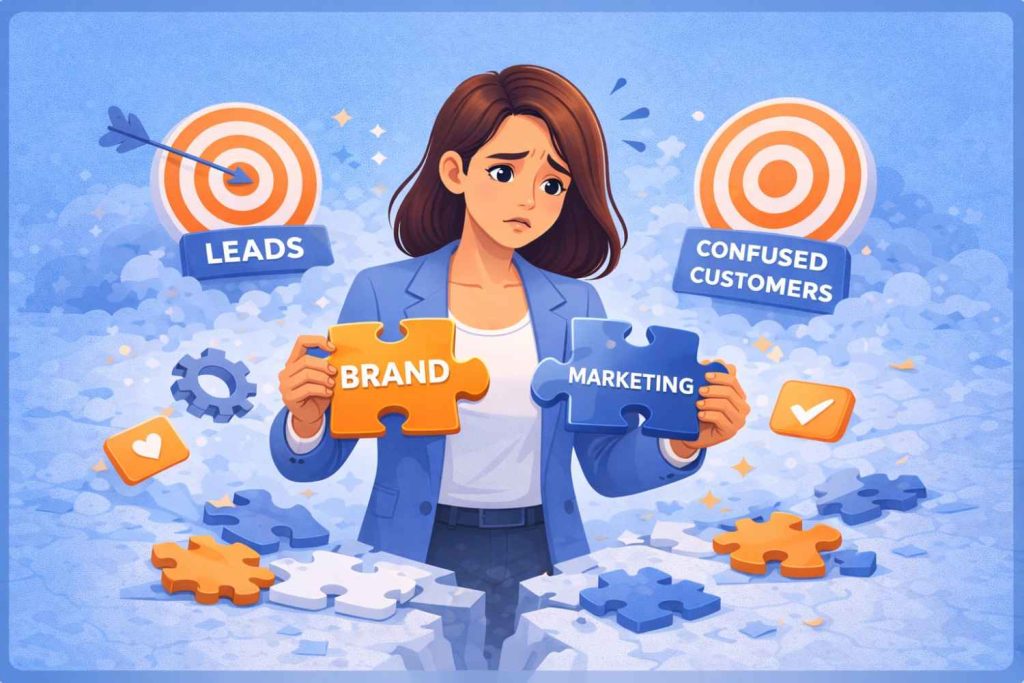
A common mistake is prioritizing execution before identity; focusing on reach before building the base layer.
Teams launch campaigns first and delay refining the brand for later. This reverses the order. Branding before marketing ensures clarity.
When branding comes after marketing, you often see:
- Mixed brand positioning
- Confusing messaging across platforms
- Inconsistent visual identity
- Unclear emotional promise
Marketing amplifies whatever exists. If there is a lack of brand clarity, amplification spreads confusion faster.
That is why conversations around why branding comes before marketing continue to surface. It is not about process preference. It is about structural stability.
Without clear branding, marketing activity becomes noise.

Why Marketing Alone Can’t Deliver Long-Term Growth
Early spurts of growth can actually mask the core structural weaknesses. A new brand may experience traction because of novelty or aggressive paid campaigns. But when acquisition costs rise and engagement stabilizes, cracks appear.
This is when leaders begin asking why good marketing fails over time.
The reason is simple and hiding in plain sight; Marketing alone cannot build attachment. It can generate awareness, but without strong brand trust, retention is bound to be fragile.
When growth declines, it is often linked to:
- Weak differentiation
- Shifting identity
- Inconsistent messaging
- Sustainability failure
This is where brand-led marketing becomes critical. Unlike purely performance-driven approaches, brand-led marketing reinforces identity. It connects campaigns to belief systems, positioning, and emotional meaning. When identity strengthens the brand loyalty strengthens.
The Cost of Inconsistency
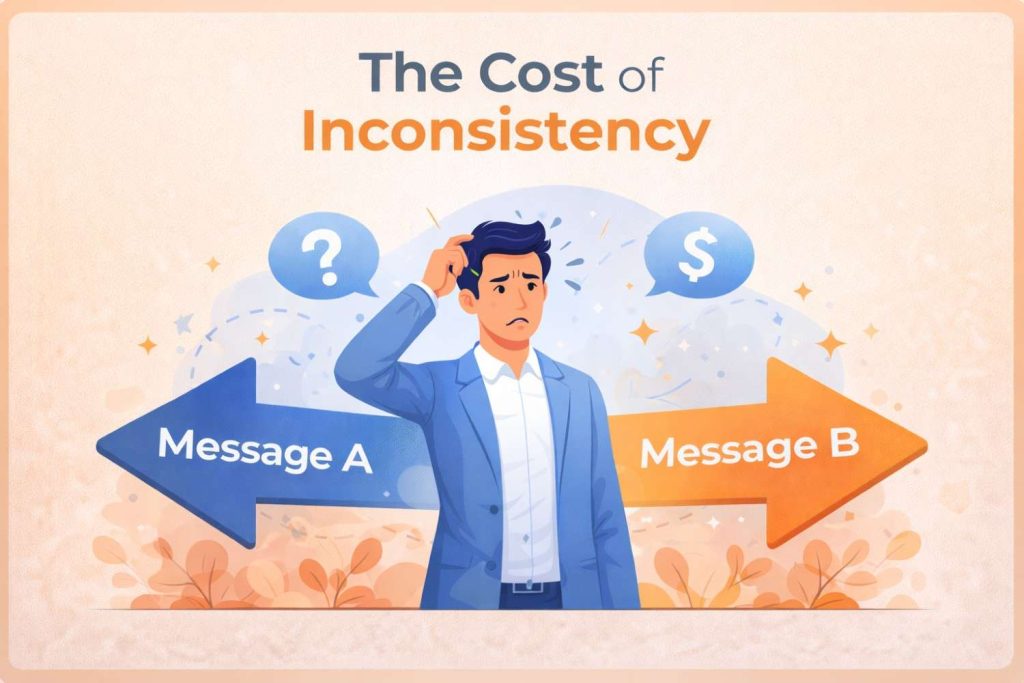
The impact of inconsistent branding may not be visible initially. It creeps up gradually.
Tone changes slightly. Messaging swaps silently. Visuals shift. Offers reposition. Each change seems minor internally. But externally, it builds up and adds to friction. Over time, these become very real problems that dilute perception.
Customers hesitate when:
- They cannot describe your value clearly
- They feel mixed signals across channels
- Your identity feels unstable
On the other hand, when the brand has a clear identity, that clarity reduces risk. When brand clarity is strong, decision-making feels easier. When clarity weakens, even good campaigns underperform.
This is why discussions around why brand consistency matters and why trust matters in marketing remain central to sustainable growth.
When Marketing Starts Working
When branding becomes clear, here are a few things that happen:
- Performance of the campaign stabalizes
- Messaging starts resonating with the audience
- Word of mouth improves
- Creative aligns naturally with the identity
- Audiences recognize patterns and start to understand your brand
- And overall, brand trust deepens
It is not that marketing suddenly becomes smarter. It is that marketing finally has a stable identity to amplify. It stops being about improvising on the fly and starts reinforcing the brand. And the relationship between branding and marketing finally aligns.
Patterns Worth Noticing
Before assuming tactics are failing, it is important to reflect on deeper signals:
- Is our brand positioning conveyed across touchpoints?
- Are we maintaining brand consistency?
- Is our messaging aligning with the brand?
- Do customers perceive us a certain way?
Marketing performs best when it works with a coherent identity. Without that foundation, even the best campaigns would struggle.

Conclusion
Marketing fails without a clear brand strategy because amplification without alignment with the identity creates fragility. Attention alone cannot build loyalty.
Sustainable growth depends on clarity, consistency, and values.
The issue is rarely effort. It is alignment.
If you’re navigating these patterns and want a clearer perspective on how branding and marketing can work together, that is a conversation worth having. At SimplePlan Media, we often explore this intersection deeply with the brands we partner with.
Frequently Asked Questions
-
What is a good marketing strategy?
A good marketing strategy aligns with strong brand positioning, reinforces brand consistency, and builds brand trust rather than relying only on short-term creative spikes.
- Why does brand consistency matter?
- When should branding come before marketing?
- What is brand-led marketing?
- How does confusing brand messaging affect growth?
Let’s get to know each other
Accelerate your business potential with our dedicated team.